
SPEED
QUALITY SUPPLIERS
EASY NAVIGATION
QUICK RESPONSES
DIRECT SHIPMENTS
GLOBAL SUPPORT
EXCELLENCE
QUALITY SUPPLIERS
PROMPT SERVICE
SATISFACTION IS
#1 PRIORITY
ECONOMICS
LOWEST PRICES
FREE FREIGHT
QUICK DELIVERIES
KNOWLEDGE
FACTORY TRAINED
OTJ EXPERIENCE
ENGINEERING SUPPORT
Analyzing Wanner Hydra-Cell Pro® Pump Diaphragm Damage

A Wanner Hydra-Cell Pro® diaphragm fails from one of four things:
- incompatibility — chemical or temperature
- over-pressurization
- mechanical interference
- cavitation
This article describes what each looks like, how to keep it from happening again, how the pump runs with a bad diaphragm, and how to put it back together.
How Long Do Diaphragms Last?
Except PTFE, a Hydra-Cell Pro® diaphragm does not have a stroke count to failure. The hydraulic balance and the built-in convolute keep flex stress low. They are not treated as a wear part.
PTFE Diaphragms
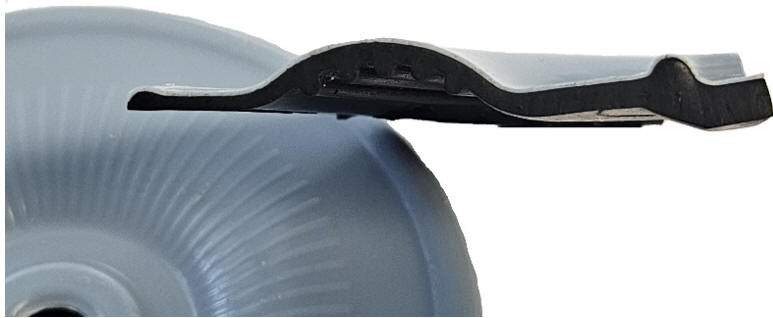
PTFE usually does have a wear life. PTFE is bonded to a neoprene backing so the stack can flex. When that design shipped in 1994 it was good for about 2,000 hours (120 million cycles). The PTFE face wears faster than a homogeneous elastomer, and the stiff face fatigues. Since 1994 the laminate has been improved for longer life and higher RPM. Extra PTFE failure modes are cracked or worn-away patches of the PTFE layer.
Chemical or Temperature Incompatibility
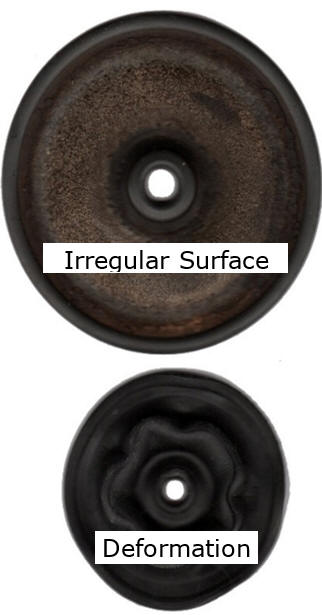
Materials: Aflas, EPDM, FKM, PTFE, Neoprene, Buna-N. Each has a window — lows around 30–80°F, highs around 120–250°F. Outside that window the rubber can deform, crack or look melted. Chemical attack and heat can look alike, so you have to look at the process. A rough, stiff face with a crack is usually chemistry. Extreme temperature tends to deform the diaphragm.
Start with a compatibility chart. Liquid blends are harder and might require soak tests or a trial run. Sometimes nothing is 100% compatible and you change diaphragms on a schedule before they fail.
Remedy: stay inside the temperature band and watch upset spikes.
Over-Pressurization
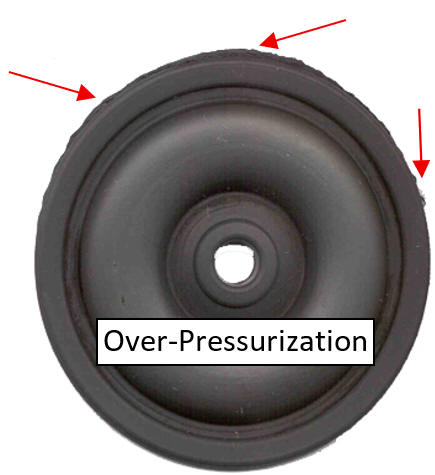
Hydra-Cell Pro pumps are rated up to 1,000 to 5,000 PSIG. Past that rating you can damage diaphragms, O-rings and the hydraulic end. Over-pressure failures usually show a frayed rim where the valve plate and housing pinched the edge. Head bolts can stretch just enough for the diaphragm and O-rings to extrude. When pressure drops, the plate closes on that edge.
A common situation: a worn PRV dumps too much flow, pressure falls, someone adjusts the PRV down, and a spray wand or fast valve then spikes past the pumps pressure rating. That pulse is enough to pinch the edge of the diaphragms. Failure is usually gradual, not a blow-out. Manifold O-rings often fray first. If those look pinched, change the diaphragms too.
Remedy: a gauge or transducer on the discharge, a PRV set correctly, and rebuild or replace a worn PRV.
Mechanical Interference
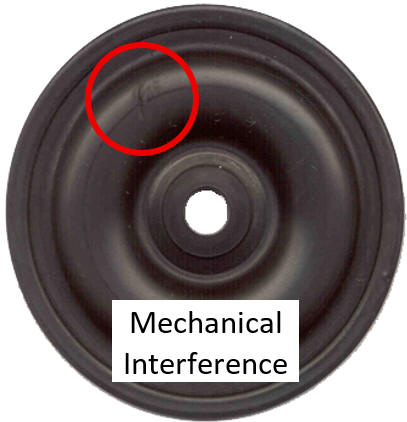
Uncommon. Something has to lodge in the pump chamber. Check-valve free passage usually stops oversized solids at the valves, not at the diaphragm. The usual case is ice: the head froze solid, or a chunk of ice is still in the chamber, and the diaphragm cannot move into that space.
Solids that drop out while the pump sits can do the same if they clump and will not re-entrain when you start.
Remedy: do not leave liquid in a head that can freeze — run dry and use the manifold drain. If you cannot run dry, flush before shutdown so nothing precipitates in the chambers.
Cavitation
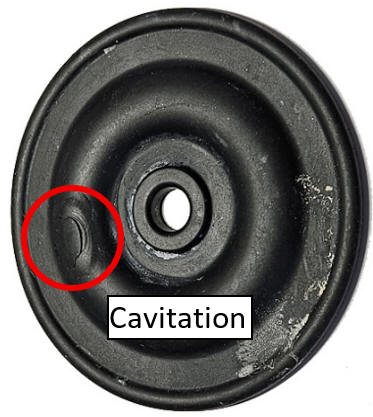
On a Hydra-Cell Pro, cavitation means the pump chamber did not fill. A plugged inlet filter, low inlet pressure, a collapsed hose or a closed valve will do it. Displacement is fixed. If the liquid flow available is less than the displacement rate, a vacuum forms and the liquid flashes.
Current-generation diaphragms are not wrecked by inlet cavitation. Starting June 2003 on D/G10, almost every current pump model is protected. Before 2003 — and on a few models that were not updated until after 2004 — cavitation could cut a diaphragm immediately. Vacuum let the hydraulically driven diaphragm over-fill with oil and rub against the outlet check valve. That left a crescent cut on the convolute.
There are still many pre-2003 pumps running although that population shrinks every year.
Diaphragm Failure
A damaged diaphragm cuts efficiency. Pulsation gets obvious and the pump gets louder. Flow or pressure instruments show it first.
A cut, crack or badly frayed rim usually dumps hydraulic oil into the head and process liquid into the oil end. If that runs long enough the bearings and pistons starve for lubrication and can be destroyed. If the process liquid does not attack those parts, recovery is: new diaphragms, drain the oil end, flush with fresh oil, refill, and purge air from behind the new diaphragms.
Pump Repair Kits
Three kits: elastomer, valve and complete. Elastomer kits are diaphragms and manifold O-rings. Valve kits are the check stacks, including tetra-seals and dampening washers where used. Complete kits contains all those components.
Valves usually drive the outage. Most shops change the diaphragms at the same time — the complete kit cost isn't much more and the time required is about the same.
or complete the inquiry form
Repair kit calculator