
SPEED
QUALITY SUPPLIERS
EASY NAVIGATION
QUICK RESPONSES
DIRECT SHIPMENTS
GLOBAL SUPPORT
EXCELLENCE
QUALITY SUPPLIERS
PROMPT SERVICE
SATISFACTION IS
#1 PRIORITY
ECONOMICS
LOWEST PRICES
FREE FREIGHT
QUICK DELIVERIES
KNOWLEDGE
FACTORY TRAINED
OTJ EXPERIENCE
ENGINEERING SUPPORT
Proper Motor Sizing for High Temperature Liquid Pumping with Wanner Hydra-Cell Pro® Pumps

This article explains how pumping high-temperature liquids affects motor sizing for Wanner Hydra-Cell Pro® pumps.
Call 908.362.9981
or submit a Hydra-Cell Pro inquiry
What Counts as High Temperature?
Datasheets and the IOM list maximum liquid temperature by head material, then say to consult the factory for temperatures from 160°F (71°C) to 250°F (121°C). That instruction goes beyond just picking temperature-compatible head components. See components in contact with the liquid.
Applications for liquids above 160°F also effectively reduce the motor size that can be used on a given Hydra-Cell Pro model. Hot liquid makes the hydraulic end run hotter, the oil thins, and bearing life drops.
Role of the Oil
This expands on our Hydra-Oil article. The oil does three jobs:
- lubricate sliding and rotating parts
- carry heat off those parts
- form the hydraulic pistons that move the diaphragms
What matters for motor sizing is the oil’s viscosity at elevated temperature. Hydra-Cell Pro pumps typically run about 180°F (82°C) oil temperature in the hydraulic end. That is the design basis for good oil film on the roller bearings. Oil hotter than that thins more, the film gets thinner, and the bearings and pistons wear faster.
You might think that if the liquid is under 180°F the pump head would act as a heat sink. The body has cooling fins and a certain surface area sized to hold the oil near 180°F. Hot liquids reduce that heat-sink effect. That is how the 160°F threshold was set. Above 160°F the hydraulic end is more likely to exceed 180°F oil temperature.
The oversized roller bearings will still give acceptable service life if the oil runs a little over 180°F, and “acceptable” varies by application. The point of this article is to explain the wear mechanism so the system can be sized correctly.
Oil Film
Higher bearing loads need a thicker oil film to prevent metal-to-metal contact. That is elastohydrodynamic lubrication (EHL). Viscosity at operating temperature and the load on the bearings set how thick the film has to be.
Bearing load is the radial or axial force on the rollers. The bearings keep the rotating parts aligned against that force. Most of the load comes from the reciprocating hydraulic pistons. Higher discharge pressure and higher shaft RPM raise the load. A larger motor can deliver more torque and RPM under load, which raises bearing load. That is why motor size is limited on hot liquid.
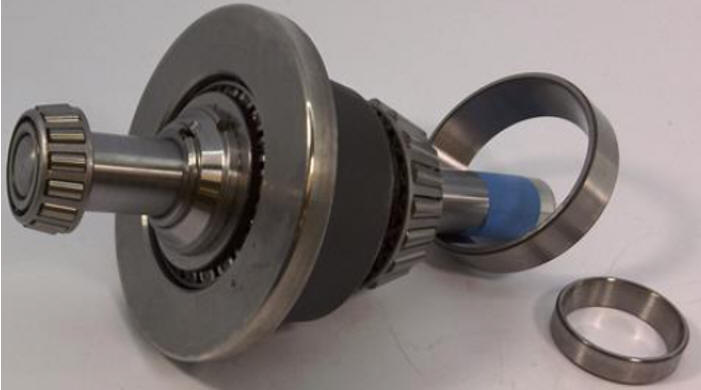
Two ways to keep the oil film near its design thickness:
- Reduce the load on the bearings by limiting motor horsepower. That usually means a larger pump turning slower. It is a design limit, not a flow limit.
- Add an oil cooler and hold the oil at or below 180°F.
Limiting Horsepower
Maximum recommended applied motor horsepower by model and liquid temperature. These are motor size limits, not calculated HPr values.
| Pump Model | Liquid <160°F (71°C) or with oil cooler |
Liquid >160–230°F (71–110°C) without cooler |
|---|---|---|
| M/D03 | 2.3 | 0.8 |
| D04 | 5.3 | 1.7 |
| D10/12 | 6.5 | 2.1 |
| D15 | 20.1 | 6.6 |
| H25 | 15.3 | 5.0 |
| D35 | 29.8 | 9.8 |
| D66 | 44.4 | 14.7 |
| T60 | 64.0 | 32.0 |
| T100 | 98.7 | 49.3 |
| Q155 | 161.0 | 80.5 |
| T200 | 203.0 | 101.5 |
| Q330 | 330.0 | 165.0 |
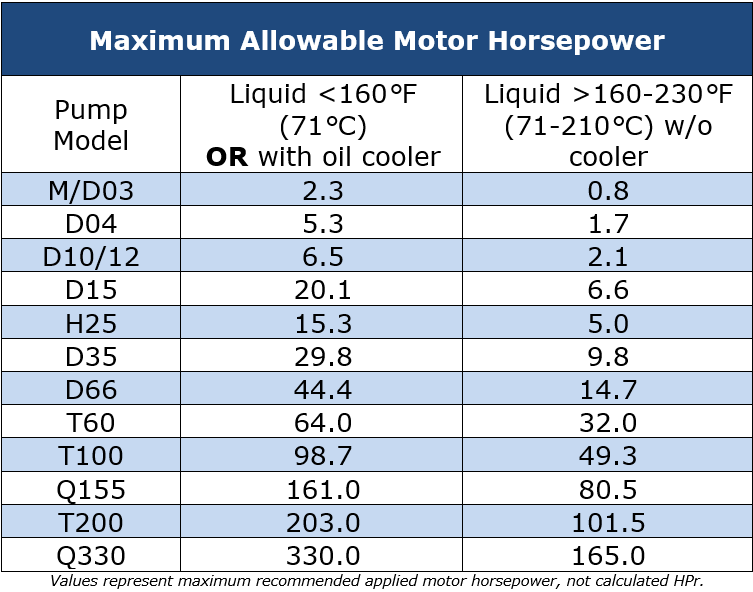
The middle column is the maximum motor size when the liquid is under 160°F or when an oil cooler is used. The right column is the maximum motor size when the liquid is above 160°F and no oil cooler is fitted.
Example
D10 with “X” cam, 4 GPM at 716 PSIG, 1,800 RPM motor, liquid above 160°F.
Using the datasheet formula (same as the web HP calculator):
For this duty the math comes to about 2.0 HPr
If a VFD is added, shaft torque at lower speeds usually requires a larger motor. That 2.0 HPr becomes about 5.4 HPr, so a 7.5 HP motor is selected.
For a D10 on liquid above 160°F the maximum recommended motor horsepower is 2.1. In this example the application HPr is 2.0, which is under the 2.1 limit, so the 7.5 HP motor with VFD is acceptable on the D10.
However, if the same VFD is later turned up to 5 GPM, HPr rises to 2.7. Even though the 7.5 HP motor and VFD can produce 5 GPM, 2.7 exceeds the D10 limit of 2.1. Two choices: add an oil cooler to the D10, or go to a larger pump that can handle the higher HPr.
Wanner® air-cooled oil cooler/filters list at $5,600–$7,200 in the 2025 price guide. That is usually cheaper than tearing out a running D10.
On a new system, price a D10 plus cooler against the next larger pump (H25) without a cooler. An H25E at 1,200 RPM for 5 GPM at 716 PSIG runs at about 288 RPM. HPr is still 2.7, but the H25 limit is 5.0, so it is acceptable without a cooler.
Note: an H25 on a VFD for this duty needs a 15 HP motor to keep shaft torque, and therefore a 15 HP VFD. See Calculating Horsepower Required.
So the choice is D10 + 7.5 HP motor + 7.5 HP VFD + oil cooler, or H25 + 15 HP motor + 15 HP VFD and no cooler. An H25 generally costs about twice a D10, it is physically larger, and the 15 HP motor and drive cost more than the 7.5 HP set. Adding the oil cooler to the D10 is the more economical path.
Without a VFD the same split holds. Belt or gearbox to the exact RPM: D10 at 2.7 HPr is over the 2.1 limit, so it still needs a cooler or an H25 (still 2.7 HPr, 5 HP limit). When the VFD is removed, the extra cost is only the larger pump and maybe a bigger baseplate.
Oversizing the pump can be cost-effective because larger frames have larger bearings (they handle higher loads) and a larger oil reservoir that dissipates heat better. Either way, the horsepower limit for liquids above 160°F has to be considered if the hydraulic end is going to last.
or complete the inquiry form
Hydra-Cell Pro horsepower calculator