-

-
SPEED
QUALITY SUPPLIERS
EASY NAVIGATION
QUICK RESPONSES
DIRECT SHIPMENTS
GLOBAL SUPPORT -

-
EXCELLENCE
QUALITY SUPPLIERS
PROMPT SERVICE
SATISFACTION IS
#1 PRIORITY -

-
ECONOMICS
LOWEST PRICES
FREE FREIGHT
QUICK DELIVERIES -

-
KNOWLEDGE
FACTORY TRAINED
OTJ EXPERIENCE
ENGINEERING SUPPORT
P300 Wanner Hydra-Cell Pro® High-Pressure Metering Pump
Seal-Less Metering Pump — 2 to 80 GPH, up to 2,500 PSI
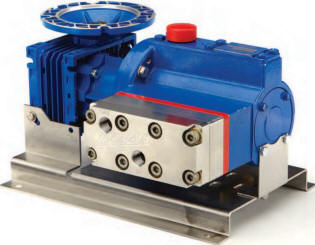
The Wanner Hydra-Cell Pro® P300 metering pump is designed specifically for high-pressure applications above 1,000 PSI and up to 2,500 PSI. (For pressures ≤ 1,000 PSI, see the P200 metering pump.) Like the other P Series models, the P300 handles a broad range of fluids — from clear water to viscous or abrasive slurries — and operates across a 50 to 2,500 PSI pressure range.
Performance satisfies API 675 standards for steady-state accuracy, linearity and repeatability. The P300 is a standard Hydra-Cell Pro Model D04 pump fitted with a gearbox. The gearbox reduces shaft speed while maintaining proper torque, allowing smaller motors and VFDs when operating within a 10:1 turndown ratio.
Call 908.362.9981 to speak with a sales engineer
or submit a Hydra-Cell metering pump inquiry form
Technical Specifications
| Specification | Details |
|---|---|
| Flow Range | 2 to 80 GPH |
| Pressure Range | 50 to 2,500 PSI (optimized for > 1,000 PSI) |
| Design | Seal-less diaphragm (based on D04) with gearbox |
| Turndown | 10:1 with VFD |
| Base Model | Hydra-Cell Pro D04 |
Control Options
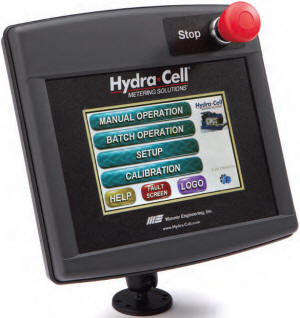
Most VFDs offer basic programmability and can interface with a customer-supplied PLC.
Complete pump/motor/VFD/PLC assemblies are available. Provide your design criteria and we will size the motor and optional controllers accordingly.
Reliability + Simplicity = Low Cost of Ownership
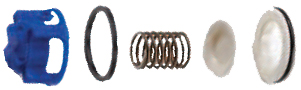
The only wetted components are the elastomers and the check valve assemblies. Elastomers themselves are not wear items; check valves are the primary wear component and typically last 9–12 months of continuous operation (approximately 6,570–8,760 hours), depending on fluid characteristics.
For abrasive duties (for example spray-drying ceramic slurries) we offer check valves in erosion-resistant materials such as ceramic and tungsten carbide. Abrasive and corrosive applications benefit from careful pump sizing and attention to fluid velocity through the pump head.
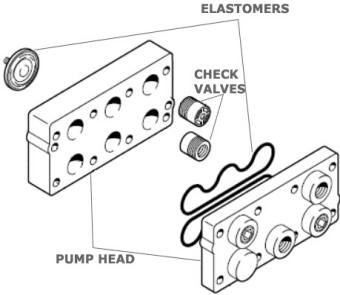
Check valves are replaced by removing the pump manifold (the first plate, held by eight cap screws). No special tools or training are required; replacement is typically completed within one hour and often without removing the pump from the process area. If elastomers are damaged by fluid incompatibility or over-pressurization, they are accessible by removing two additional cap screws that secure the check-valve manifold to the pump body.
Additional Technical Resources
Call 908.362.9981
or complete the metering pump inquiry form
We typically respond the same business day with a detailed proposal.