
SPEED
QUALITY SUPPLIERS
EASY NAVIGATION
QUICK RESPONSES
DIRECT SHIPMENTS
GLOBAL SUPPORT
EXCELLENCE
QUALITY SUPPLIERS
PROMPT SERVICE
SATISFACTION IS
#1 PRIORITY
ECONOMICS
LOWEST PRICES
FREE FREIGHT
QUICK DELIVERIES
KNOWLEDGE
FACTORY TRAINED
OTJ EXPERIENCE
ENGINEERING SUPPORT
Wanner Hydra-Cell Pro® Pumps for Triethylene Glycol (TEG) Injection

![Typical Triethylene Glycol Injection [TEG] System](https://innovativepumps.com/images/TEG-pump-system.jpg "Typical Triethylene Glycol Injection [TEG] System")
Natural gas dehydration is a required step in upstream and midstream processing. Moisture has to come out of the gas to meet pipeline specifications, keep hydrates from forming, and protect downstream equipment. TEG dehydration is still the method used most often because it holds up across a wide range of operating conditions.
Pump selection drives how well that loop runs. High-pressure pumps have to circulate glycol continuously, hold a stable flow, and live with hot, dirty fluid. Wanner Hydra-Cell Pro® pumps are used on that duty as an alternative to packed plunger pumps and gear pumps.
Call 908.362.9981
or submit a Wanner Hydra-Cell Pro® pump inquiry
Why Natural Gas Must Be Dried
Produced gas carries water vapor. Left in the stream it causes corrosion, freezing and hydrate plugs in pipe and process equipment. Dehydration brings the gas to pipeline sales spec and keeps the system from icing or corroding.
TEG is a liquid desiccant. It is hygroscopic and has a high boiling point, so it takes on water in the contactor and gives that water back in the regenerator, then returns to the tower.
Basic TEG Process
A typical unit is a counter-current absorber. Wet gas enters the contactor. Lean glycol is fed at the top. Gas rises, glycol takes on water, and dry gas leaves the top of the tower.
Rich glycol leaves the contactor and goes to regeneration. Heat drives the water off. Lean glycol is pumped back to the contactor. That closed loop runs continuously and needs a pump that can deliver hot glycol against high discharge pressure.
Pumping Requirements
Wanner Hydra-Cell Pro® pumps cover two jobs in the loop:
- Move rich glycol from the contactor to regeneration
- Return lean glycol from regeneration to the contactor
Circulation requires metering-pump accuracy to satisfy the moisture spec.
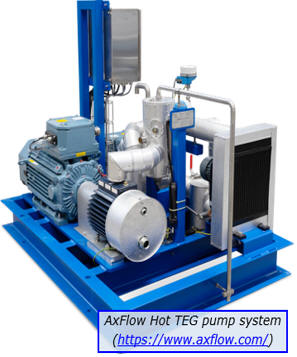
Many upstream contactors run above 1,000 psi. The pump has to overcome that pressure and still hold flow. High-pressure service shows up in:
- Lean glycol injection into high-pressure contactors
- Transfer across long lines or elevated pipe racks
- Regeneration and stripping-gas systems that need stable flow
Performance Challenges
TEG service is hard on conventional pumps:
- Continuous duty with little tolerance for downtime
- Glycol that carries contaminants or solids
- Entrained gas or vapor in the stream
- High differential pressure
- Repeatable flow, not just average flow
Those conditions are where packed plunger pumps and gear pumps start to leak, wear or lose accuracy.

How Other Pump Types Compare
Plunger Pumps
Plunger pumps are common on field units because the flow is relatively low and they make high pressure. They rely on packing that leaks as it wears. Metering accuracy falls with that wear. High liquid temperature shortens packing and plunger life.
Diaphragm Metering Pumps
Hydraulic diaphragm metering pumps are used when dosing accuracy is specified. They add a hydraulic system and stroke or eccentric adjustment. Simplex designs are more sensitive to pressure spikes and hydraulic imbalance, and they do not like solids or gas in the process fluid.
Gear Pumps
Gear pumps are simple and give a steady flow at moderate pressure. Contaminated glycol wears the gears. Efficiency changes with viscosity, pressure and wear, so they usually will not hold API 675 metering performance for the life of the unit.
Hydra-Cell Pro® Pump Technology
Hydra-Cell Pro® pumps are a hydraulically balanced, multi-diaphragm positive-displacement design. A cam drives hydraulic oil against the diaphragms; process fluid moves through check valves. There is no packing or mechanical seal on the process side. That sealless wet end keeps glycol in the pipe and off the skid.
Seal-Less Design
No dynamic process seal means less fugitive emission and less exposure to hot glycol.
Entrained Gas
Glycol often carries dissolved or free gas. Plunger and gear pumps cavitate or run dry at the seal. Hydra-Cell Pro pumps tolerate vapor without that damage.
Maintenance
There is no packing to adjust. Typical service is 3 quarts of 15W-50 synthetic oil every 4,000 hours and a check-valve kit (about $750 as of February 2026) every 8,000+ hours. Oil and valves can be changed in place. No special tools or bench work.
High Pressure
The multi-diaphragm layout spreads the load. TEG loops are typically under 2,000 PSIG, inside the Hydra-Cell Pro range.
Accurate Flow
Hydra-Cell Pro pumps meet API 675 for repeatability, steady-state accuracy and linearity. That is the control the contactor needs to stay on spec.
Contaminated Fluid
TEG picks up particulates, degradation products and corrosion debris. Moderate solids do not destroy a Hydra-Cell Pro wet end the way they score a plunger or a gear set, so filtration can be coarser.
Modernizing TEG Pumping Systems
Dehydration units are expected to run with less supervision. Reliability is the operating cost. Replacing packed plungers or gear pumps with a sealless multi-diaphragm pump reduces leak points, packing work and unplanned stops.
Hydra-Cell Pro pumps fit the duty where pressure is high, gas is in the glycol, and increased reliability.
Conclusion
TEG remains the standard for gas drying. The pump is what keeps lean glycol on rate at contactor pressure. Packed and geared pump designs have done that work for decades; they leak and they wear. A sealless Hydra-Cell Pro pump holds pressure, holds flow and keeps glycol in the system.
Related Articles
- Comparison of Hydra-Cell Pro® and Plunger Pumps
- Comparison of Hydra-Cell Pro® and External Gear Pumps
- Centrifugal Vortex Gas/Liquid Separators for Natural Gas Processing
- Horsepower Requirements for Pumping High-Temperature Liquids
- NOx reduction with Hydra-Cell Pro® pumps
- Hydra-Cell Pro® design overview
Call 908.362.9981
or complete the inquiry form
We typically respond the same business day.