
SPEED
QUALITY SUPPLIERS
EASY NAVIGATION
QUICK RESPONSES
DIRECT SHIPMENTS
GLOBAL SUPPORT
EXCELLENCE
QUALITY SUPPLIERS
PROMPT SERVICE
SATISFACTION IS
#1 PRIORITY
ECONOMICS
LOWEST PRICES
FREE FREIGHT
QUICK DELIVERIES
KNOWLEDGE
FACTORY TRAINED
OTJ EXPERIENCE
ENGINEERING SUPPORT
Wanner Hydra-Cell Pro® Pump Compared to Magnetically Driven Gear Pumps

Earlier articles covered difficult liquids and a Wanner Hydra-Cell Pro® metering pump against an external gear pump. The sealless multi-diaphragm design also competes with internal gears designs and their mag-drive versions. The differences show up in reliability, maintenance cost and which types of liquids each pump is designed to handle best.
Design Overview
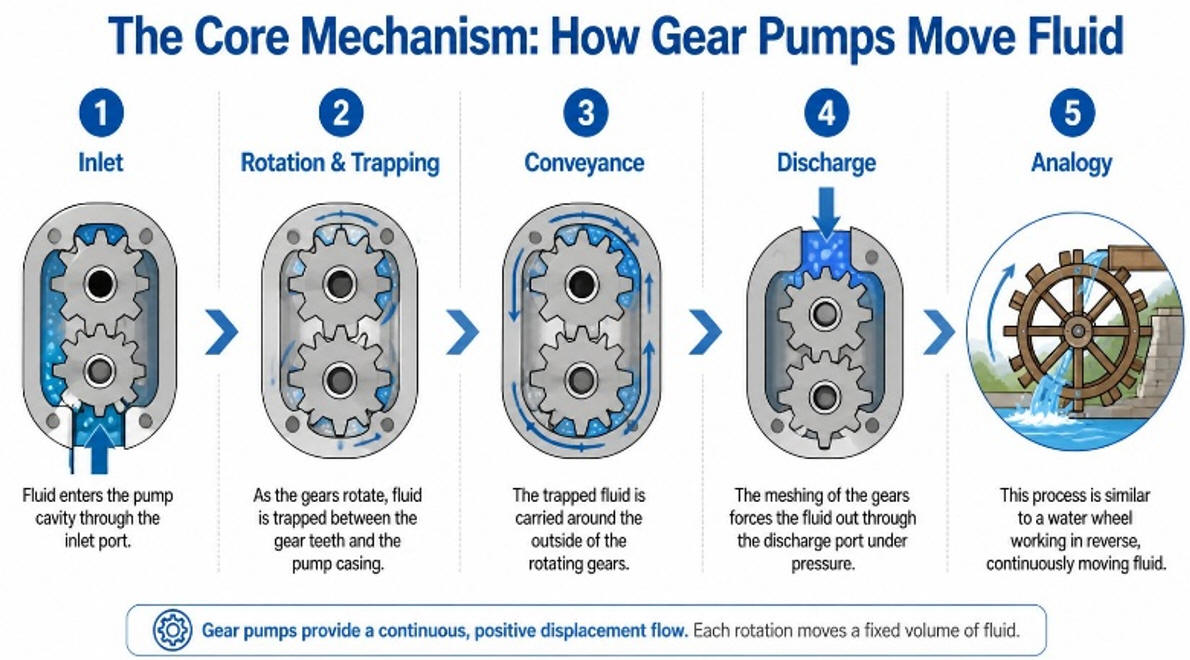
An external gear pump uses two identical gears that mesh outside each other. Liquid rides in the tooth spaces against the casing from inlet to outlet. The layout is simple, pressure is higher than most internal gear pumps, and you see them on hydraulic and transfer duty.
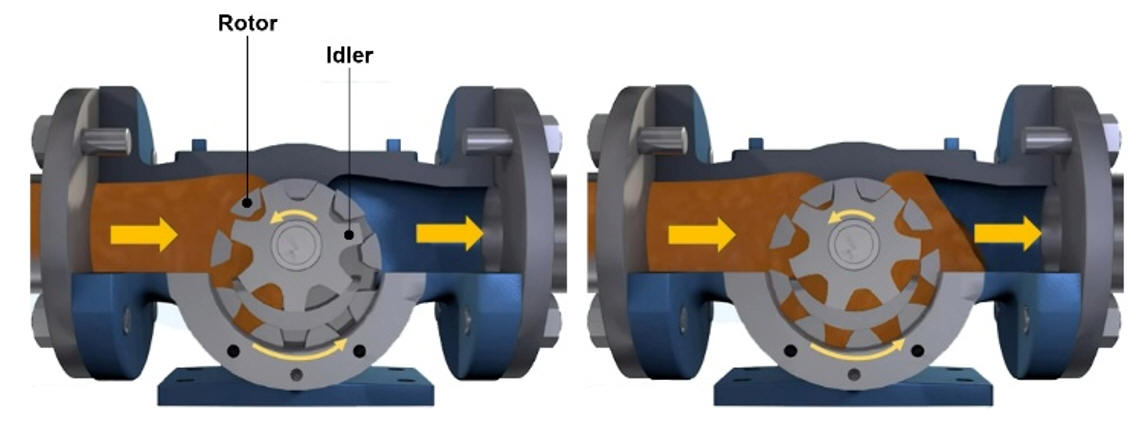
An internal gear pump uses a large outer gear with internal teeth and a smaller pinion. A crescent separator forms the chambers. Flow is smoother and viscosity capability is better than an external gear design. Maximum pressure is usually lower.
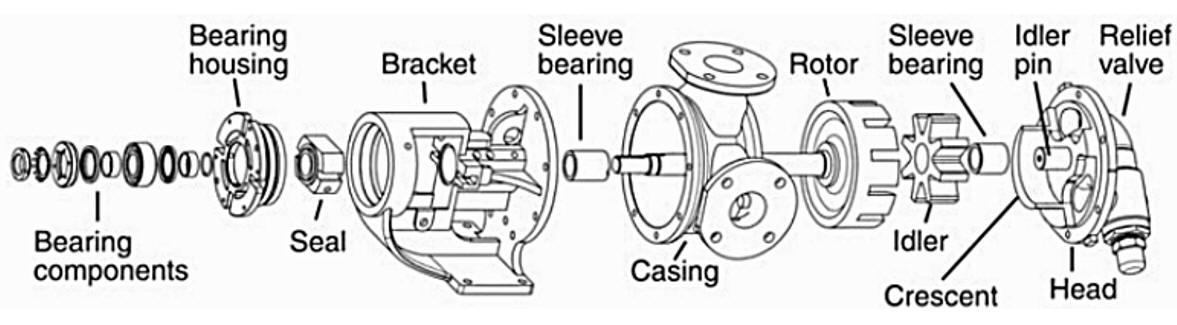
A mag-drive version of either style drops the shaft seal and uses a magnetic coupling. That leak path is gone, which is why plants use them on hazardous, toxic or expensive liquid. The process fluid still has to lubricate the bearings inside the containment shell. The magnetic coupling also limits torque and heat.
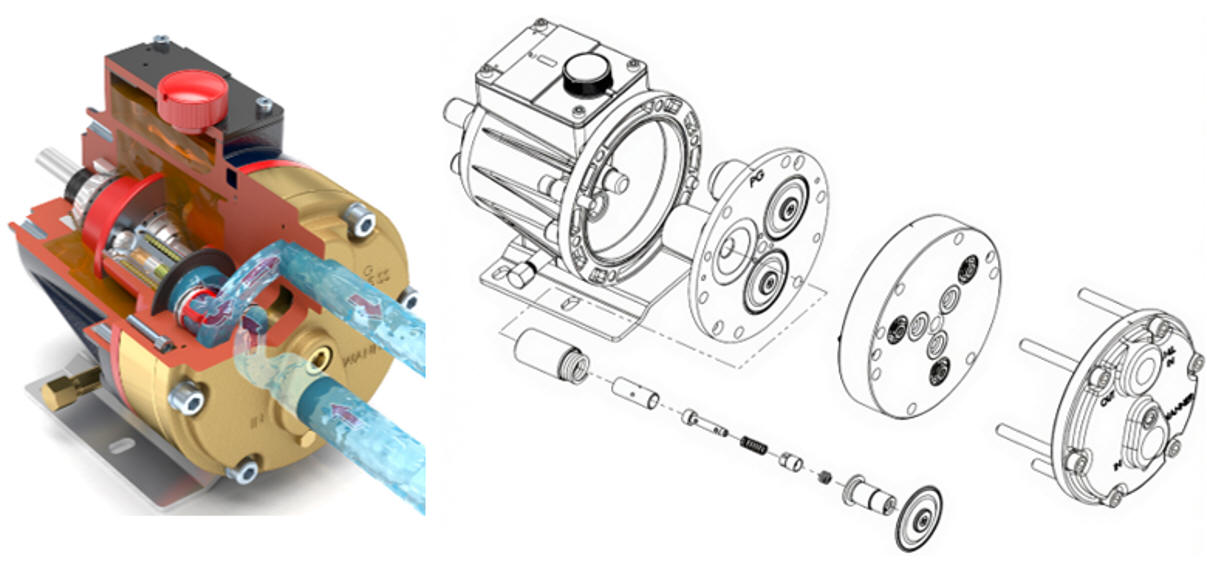
A Wanner Hydra-Cell® Pro is a multi-diaphragm sealless PD pump. Hydraulically balanced diaphragms isolate the liquid from the drive. No dynamic seal in the process. Check valves set flow direction. Three- and five-diaphragm models have very little pulse.
Key Performance Differences
Seals and Wear Components
Gear pumps — mag-drive included — run on tight gears, bushings or bearings, and, on sealed frames, packing or a mechanical seal. Those parts are exposed to the process liquid. Abrasives, thin non-lubricating fluid and dry running wear them. A mag-drive still needs the process liquid to lubricate and cool the internal bearings; if it loses prime it can be quickly damaged.
A Hydra-Cell Pro has only the check valves and elastomers in contact the liquid. The diaphragm is a static seal. No gears or bearings spinning in the process. Valves are the wear part and are swapped out in the field with ordinary tools. The pump can run dry indefinitely.
Filtration Requirements
Gear clearances are tight. OEMs often want a 5 micron absolute level of filtration, an expensive ongoing requirement.
A Hydra-Cell Pro will pass solids of several hundred microns, depending on the model. Nominal-rated filtration is usually enough, so filter cost drops.
Viscosity and Efficiency
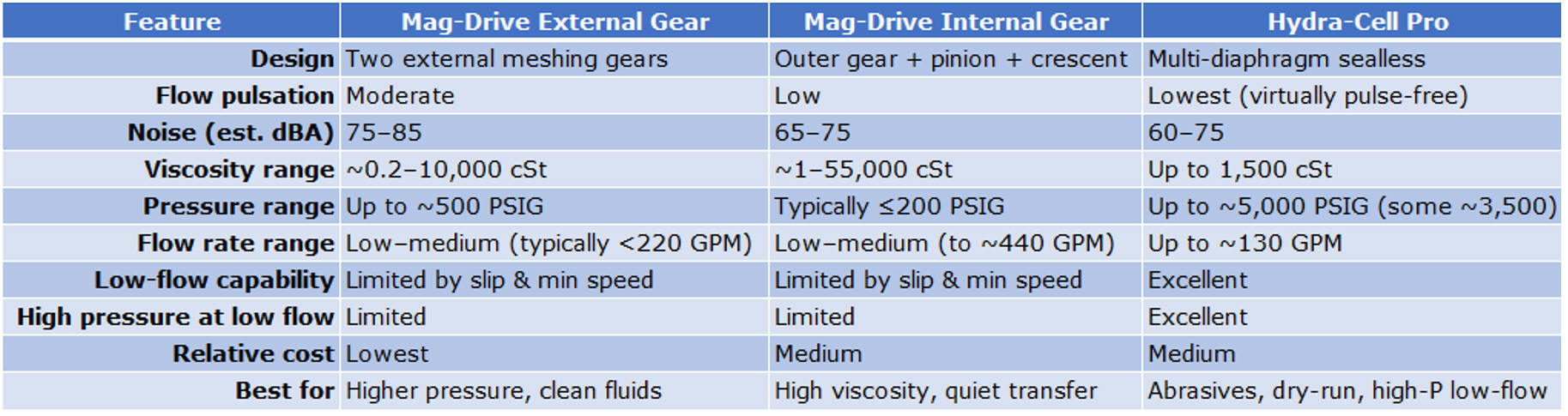
Thin liquid slips through gear clearances and volumetric efficiency falls. High viscosity raises torque. On a mag-drive that can decouple the magnets or damage the coupling. Internal gear pumps handle viscosity better than external; both still have a ceiling.
Hydra-Cell Pro efficiency stays close to its published performance across its viscosity range. Spring-loaded check valves open and close fast. There is no rotating clearance for liquid to slip through.
Pressure Capability at Low Flow
This is where Hydra-Cell Pro pulls away. A gear pump can slow down for low flow, but slip climbs and accuracy falls, more so at high differential pressure. Mag-drive torque is another cap.
A Hydra-Cell Pro holds volumetric efficiency across a wide speed band and will make high pressure at very low flow without that same slip. Models go to 5,000 PSIG and still provide API 675 metering performance.
Pulsation and Noise
External gears pulse more. Internal gears are smoother. A three- or five-chamber Hydra-Cell Pro is the quietest of the three and leaves the least residual pulse.
Materials Flexibility
Hydra-Cell Pro liquid ends come in a wide set of metals, non-metals and elastomers. Mag-drive gears are boxed in by what the gears, bearings and containment shell can be made from.
Cost of Ownership
A mag-drive external gear is often the cheapest to buy. Internal gear and Hydra-Cell Pro sit in a similar middle band. Operating cost is where they separate: filtration, seals and bearings, downtime from dry-run or grit, and shop rebuilds on a precision gear set. A Hydra-Cell Pro valve kit is inexpensive and plant personnel can change it.
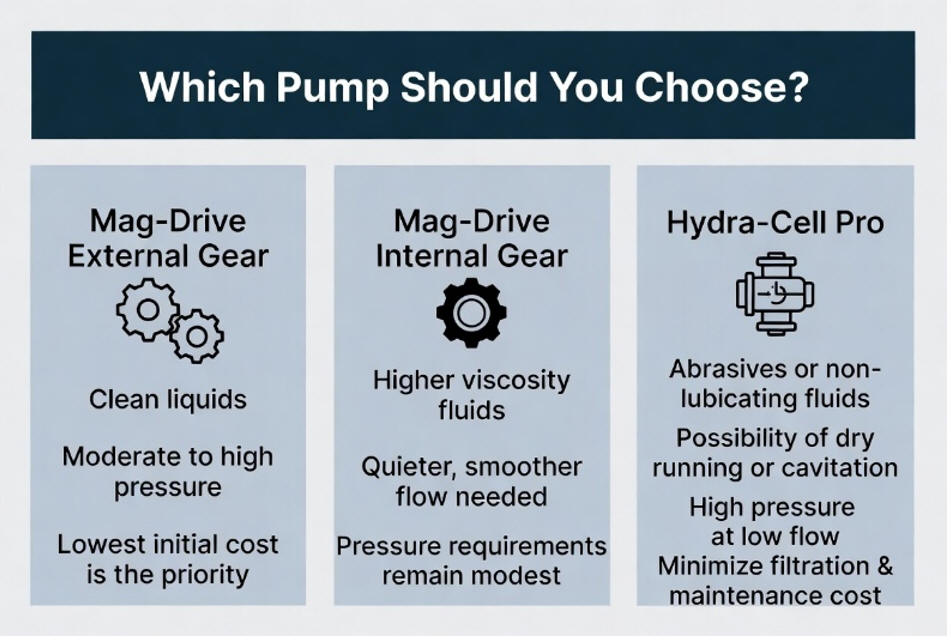
There is overlap. If a gear pump is costing you filters, seals or unplanned stops — or you are sizing a new job and are not sure which technology wins over the life of the pump — send us your design criteria. We have been applying Hydra-Cell Pro pumps for more than thirty years. A short call usually settles whether Hydra-Cell Pro pumps are the better fit or whether another design is warranted.
Related Articles
- Hydra-Cell Pro vs external gear pumps for metering
- Hydra-Cell Pro vs AODD
- Hydra-Cell Pro vs piston and plunger pumps
- Hydra-Cell Pro vs progressing cavity pumps
- Pumping difficult liquids
- Hydra-Cell Pro design overview
or complete the inquiry form